The main trends shaping intelligent manufacturing solutions for wearables are miniaturization, low-power connectivity, edge processing, sensor integration, ergonomic design, and design for manufacturing (DFM). These trends reflect the need to keep wearable devices light, energy-efficient, connected, durable under movement or sweat, and practical to assemble within a very small physical envelope.
Because these requirements interact, electronics, battery management, sensing, mechanics, and manufacturability increasingly have to be developed together. The manufacturing strategy has to preserve user-facing performance while making the product repeatable at scale, which turns system integration into the central technical challenge.
Miniaturization Is Shifting from Size Reduction to System Density
Miniaturization in intelligent manufacturing solutions is now less about shrinking individual parts than about controlling total system density. That density is a core coordination problem for turnkey manufacturing solutions because PCB area, component height, antenna location, battery volume, sensors, connectors, and mechanical supports all compete inside the same wearable.
Shrinking the enclosure without reorganizing these relationships can reduce radio performance, make thermal behavior less predictable, or leave no practical assembly access. The trend therefore favors co-design of industrial, mechanical, and electrical elements; shrinking each part independently no longer solves the system-level problem.
Human-machine-interface design adds another constraint because controls, displays, indicator placement, and contact surfaces must remain usable at wearable scale. Mechanical structures also influence comfort and motion. A board that fits geometrically may still create a rigid pressure point, while a battery placed for maximum capacity may shift weight to an uncomfortable location.
Successful miniaturization balances electronic density with the way the object sits, moves, and is handled on the body. Material and antenna choices can add further constraints. A conductive frame, a densely packed battery, or a user’s body can alter radio behavior, so compactness has to be evaluated with the complete physical stack rather than from PCB dimensions alone.
Power, Connectivity, and Edge Intelligence Are Converging
Power management becomes more demanding as sensing grows richer in intelligent manufacturing solutions. Cellular, Wi-Fi, Bluetooth, or BLE functions add another energy load, so turnkey manufacturing solutions have to prevent radio activity from consuming a disproportionate share of battery energy.
Battery-management engineering, sleep states, processor selection, sensor duty cycles, and wireless transmission patterns all contribute to energy consumption. More functions therefore do not automatically justify a larger battery; efficient system behavior can be just as important as capacity.
Edge AI increases the pressure on this balance. Processing data locally can reduce dependence on constant cloud communication and can support faster device responses, but it raises requirements for processor capability, memory, firmware stability, and PCB architecture.
High-fidelity sensor integration has a similar effect because better data depends on electrical design, mechanical placement, calibration conditions, and software interpretation. The wearable becomes an interaction between sensing quality and computing efficiency rather than a collection of independent modules.
Wearable Mechanics Must Be Designed for Real Motion
Real motion changes the mechanical problem for intelligent manufacturing solutions used in wearables. Flexing, impacts, sweat exposure, optical alignment shifts, and repeated handling all enter the design equation. Those motion-related constraints then carry into turnkey manufacturing solutions at the mechanical-design and production stages.
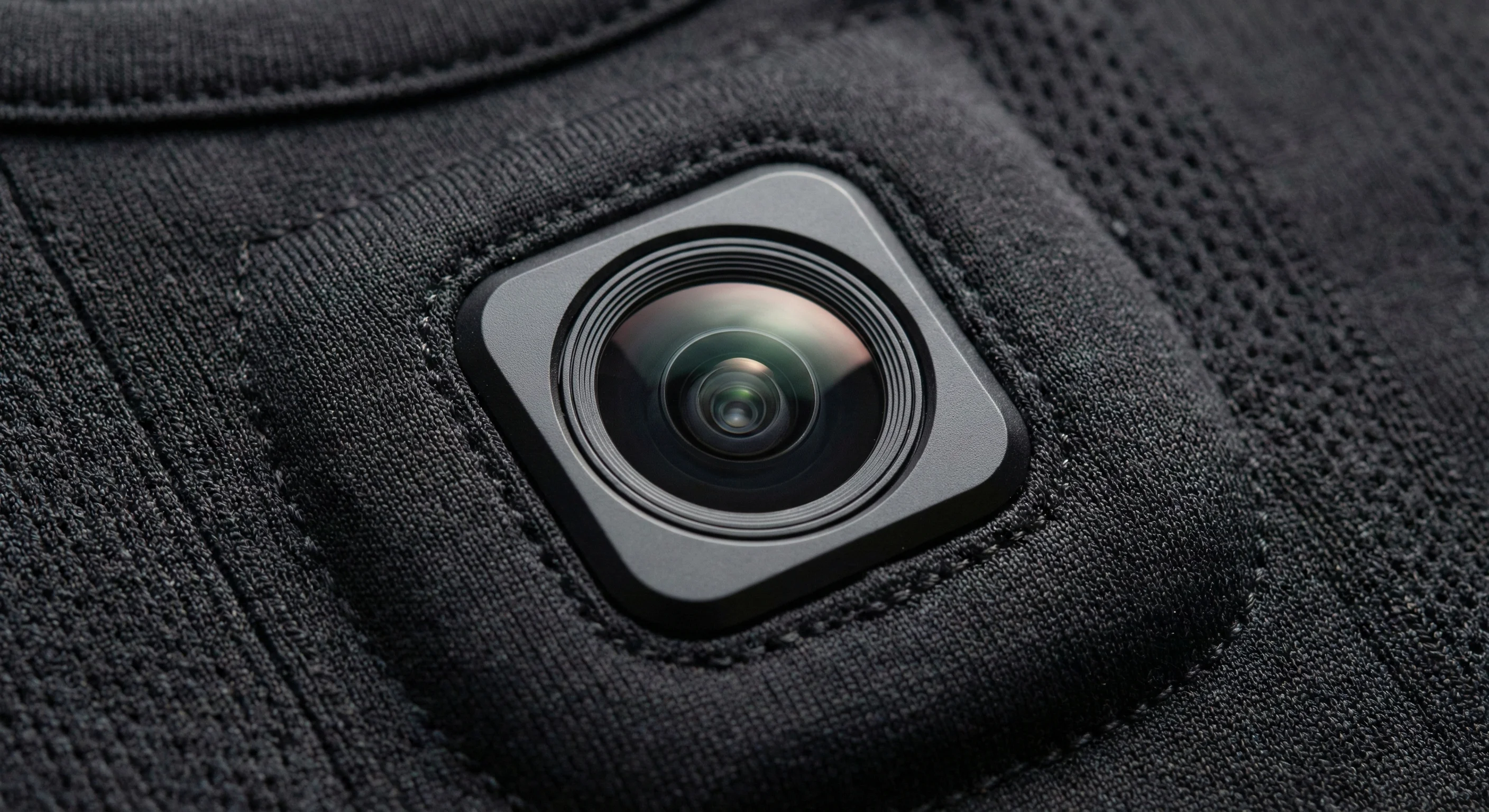
The interaction is visible in Minewing’s smart sports vest project. A lightweight stabilized high-definition camera had to be integrated into an ergonomic garment, supported by custom PCB hardware, firmware for image stabilization and processing, and selected optical-sensor and battery components.
A different Minewing project, a smart UV-monitoring watch, combined outdoor UV measurement with real-time alerts and required concept realization, project and supply-chain management, rapid design validation, hardware-software integration, and production scaling.
These examples show why mechanical design cannot be separated from sensing or firmware. A camera module must remain physically stable for image processing to work as intended, while a body-worn environmental sensor needs a structure that exposes the sensing element appropriately without compromising the rest of the product.
DFM and Scalable Validation Complete the Wearable System
A working wearable is not yet a scalable one. Earlier DFM has therefore become a defining feature of intelligent manufacturing solutions; turnkey manufacturing solutions use that stage to optimize PCB layouts and mechanical structures for yield, assembly time, and cost before volume release.
Functional prototypes can expose integration problems, but small-batch trials are needed to determine whether workers, fixtures, test equipment, and component supply can reproduce the design consistently. A wearable that works in a lab still needs a process that controls alignment, fastening, firmware loading, test steps, and final inspection.
Minewing‘s sports-vest project used functional-prototype validation and small-batch trials to establish a production route for sweat-resistant wearable electronics. That progression connects the headline trends: miniaturization creates density, low-power design preserves runtime, wireless and Edge AI increase system complexity, ergonomic mechanics keep the device usable, and DFM makes the combined design producible.
The most important direction is integration, because every additional wearable function has consequences for power, space, firmware, sensing, mechanical structure, and assembly. Wearable manufacturing is being shaped by the need to solve competing constraints as one system. Smaller electronics alone are not enough if battery life, radio performance, sensor quality, comfort, or assembly consistency deteriorate.
Edge processing and richer sensing add capability, but they also increase demands on firmware and PCB architecture. Ergonomic structures have to protect and position the embedded electronics under real motion, while DFM and trial production translate the design into repeatable work.
Minewing’s UV watch and sports-vest projects show how these trends meet in practice: user experience, electronics, software, mechanics, sourcing, and scale have to operate as one system because optimizing any single discipline in isolation can destabilize the others. As wearable functions become denser, that systems view becomes more important than optimizing any isolated component.
