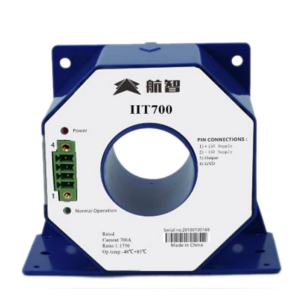
Metrology-grade current measurement requires more than a low percentage error on a datasheet. Metrology-Grade Fluxgate Current Sensors should be assessed through accuracy, linearity, offset, temperature drift, bandwidth, noise, response time, isolation, and long-term stability.
The right selection also depends on whether the application involves DC, AC, pulsed, or complex waveforms. Hangzhi develops high-precision current and voltage transducers around multi-point zero-flux control, with published accuracy reaching 10 ppm and linearity at 2 ppm.
What Defines Metrology-Grade Current Measurement?
Accuracy is only one part of the measurement equation. A sensor may show excellent initial accuracy while producing a larger system-level error after temperature changes, supply variation, external magnetic interference, or prolonged operation. Offset, gain stability, linearity, hysteresis, noise, and thermal drift should be examined individually rather than compressed into a single specification.
Linearity becomes especially important in calibration and precision power analysis because measurement error can vary across the current range. A sensor that performs well around nominal current may behave differently near zero or close to its maximum rating. Testing several positive and negative current points provides a clearer picture of the actual transfer characteristic than checking only one operating condition.
Match Bandwidth With the Measurement Signal in Metrology-Grade Fluxgate Current Sensors
Bandwidth determines how faithfully a sensing system can reproduce changing current. Slow energy monitoring, precision DC measurement, inverter analysis, and transient testing do not impose identical requirements. A wider bandwidth can preserve faster waveform components, but it does not automatically translate into better measurement quality if switching noise and unwanted harmonics become dominant.
Response time should be reviewed alongside bandwidth rather than treated as a substitute for it. Bandwidth describes frequency behavior, while response time indicates how quickly the output follows a change in the input. Hangzhi’s AIT Series provides response times of 1 μs and bandwidth options up to 800 kHz, depending on configuration. Current amplitude may need derating as frequency rises because of magnetic-core losses.
A useful specification review also considers the waveform itself. A converter may contain a DC component, switching ripple, high-frequency harmonics, and short transient events simultaneously. Fluxgate Current Sensors can accommodate AC, DC, pulsed, and complex signals while maintaining galvanic isolation, making the technology relevant to measurement platforms that cannot be reduced to a simple sinusoidal current. Metrology-grade selection of fluxgate current sensors should treat bandwidth as one part of accuracy, offset, and stability under the intended measurement conditions.
Evaluate Range, Drift, and Isolation Together
The current range should cover the intended operating region without sacrificing useful resolution at the lower end. Extremely wide ranges can be attractive, but a specification should be checked for accuracy at different percentages of nominal current. Peak current capability also needs separate consideration because short transient overloads and continuous RMS operation create different thermal and magnetic conditions.
Galvanic isolation is another major distinction between sensing architectures. It separates the measurement circuit from the conductor carrying the measured current and can simplify high-voltage measurement arrangements. The required isolation voltage, insulation distance, transient withstand capability, and installation category still need to match the application rather than being inferred from the presence of isolation alone.
Hangzhi’s AIT Series illustrates how these specifications can be considered together. The portfolio provides a 1–10,000 A current measurement range, 10 ppm accuracy, and bandwidth options of 800 kHz or 500 kHz depending on configuration. Hangzhi’s IIT Series extends the range to 30 kA with 0.02% accuracy and 100 kHz bandwidth. Its specifications provide a practical reference point for comparing range, accuracy, and dynamic capability without making the product itself the focus of the selection process.
Compare Architecture With the Application
Shunt sensing offers a direct electrical measurement method, but the sensing resistance introduces power dissipation that increases with current. Hall-effect technology avoids most of that insertion loss and supports isolated AC/DC measurement, although offset and thermal characteristics can become important in precision applications. Fluxgate architectures use magnetic null-detection to achieve very low offset and drift, which can be particularly useful when measurement accuracy must remain stable across temperature and time.
External magnetic fields should also be considered during evaluation. Busbar placement, adjacent conductors, steel structures, switching components, and enclosure geometry can influence magnetic measurement. A laboratory result may not represent field behavior inside the final machine, so application-level validation should reproduce the actual mechanical arrangement wherever practical.
The final comparison should include integration factors that are sometimes overlooked: supply voltage, output format, mounting method, aperture dimensions, thermal environment, connector design, calibration procedure, and service requirements. The About Hangzhi page provides additional information about the company’s approach to precision current and voltage measurement, while technical teams can use the broader specifications to determine whether a particular sensing architecture fits the intended measurement chain.
Conclusion
A metrology-grade selection process begins with the error sources that matter most to the application, then works outward toward bandwidth, isolation, mechanical integration, and lifetime stability. A laboratory calibration bench may prioritize ppm-level accuracy and minimal drift, whereas an industrial converter can place greater weight on bandwidth, overload behavior, thermal performance, and installation constraints.
Fluxgate Current Sensors become especially relevant when low offset, stable linearity, galvanic isolation, and broad dynamic behavior are required together. Hangzhi offers multi-point zero-flux current and voltage measurement technology with published specifications covering 1 A to 30 kA, 10 ppm accuracy, and 2 ppm linearity. The About Hangzhi information can provide further technical background, and teams evaluating a specific application may contact us to discuss measurement requirements.
