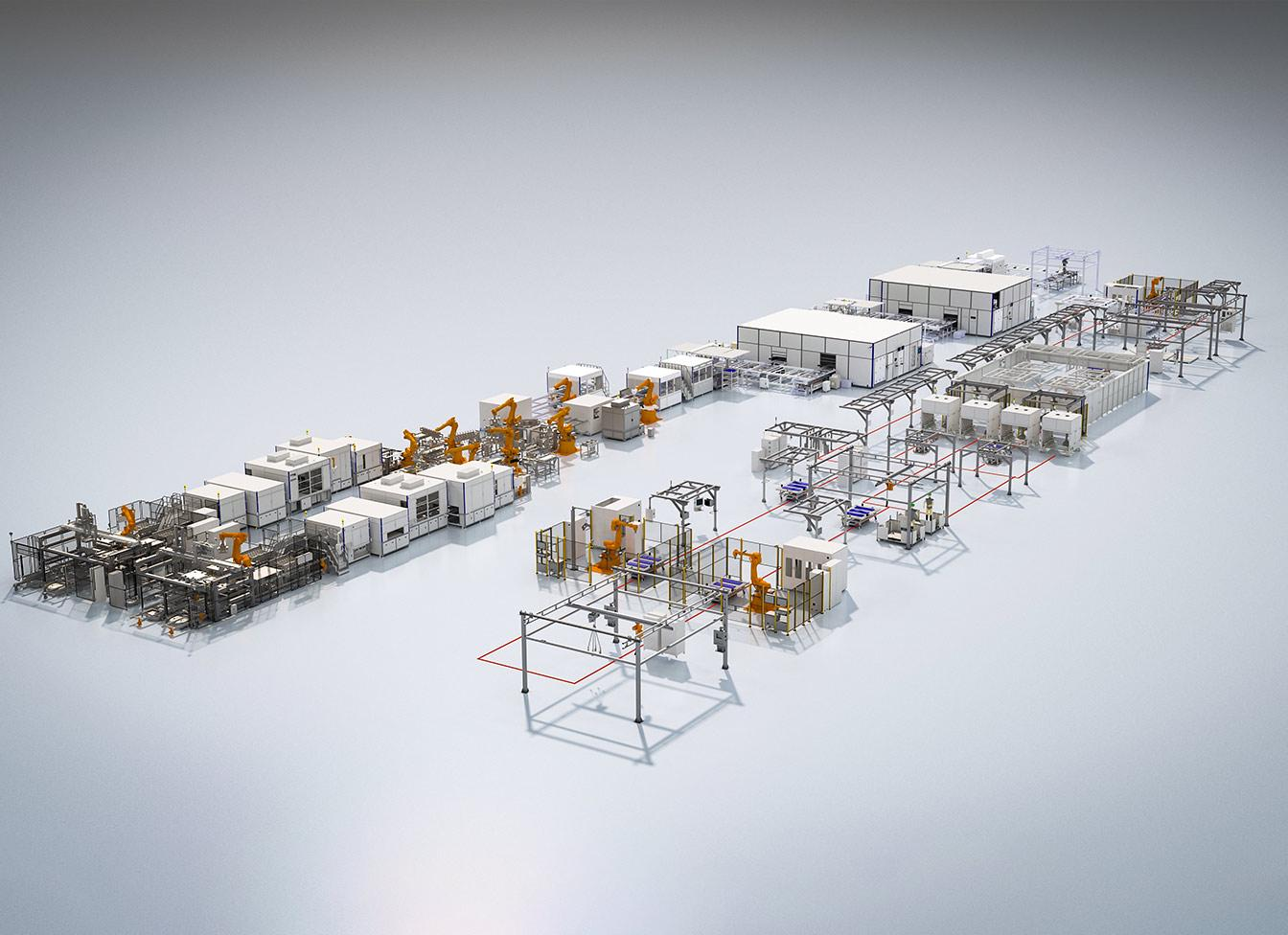
Blade battery production places particular demands on automation because long-format cells must be handled, positioned, tested and assembled through a controlled sequence. For manufacturers planning a new production line, equipment selection should therefore be based on the complete process rather than a single machine.
A capable blade battery assembly line should connect material handling, identification, testing, assembly, welding, inspection and data management. The supplier should also understand how transport technology and production control interact across multiple stations.
Cell Handling Sets the Foundation
The first consideration is how cells enter and move through the line. Long cells require controlled feeding and positioning so that orientation remains consistent before testing or assembly. Automated barcode scanning can also connect individual cells with production information and process records.
FHS’s blade battery assembly line integrates AGV-based material handling, CCD-guided cell handling, code scanning, OCV testing, NG cell replacement, gluing, aerogel application, vision inspection, and module assembly. This shows why material handling should be planned together with testing and downstream operations rather than treated as an isolated conveyor task.
Process Integration Matters More Than Individual Machines
Battery module production normally involves several operations in sequence. A professional supplier needs to understand how these stations exchange products, signals and production data. If each machine is designed independently, transfers between stations can create additional handling, alignment or communication requirements.
The published FHS blade battery line covers cell stacking and module assembly, terminal addressing, insulation testing, busbar welding and weld inspection, nickel plate installation and welding, EOL testing, PACK box gluing, module loading, and final PACK testing. A connected process architecture can help manufacturers define where inspection, buffering and traceability should sit within the overall line.
Accuracy Needs to Follow the Battery Structure
Positioning requirements depend on the dimensions and assembly structure of the battery. A blade battery assembly line manufacturer should therefore evaluate tooling, motion control and fixture design according to the actual cell and module configuration.
FHS applies flexible transport technology to battery manufacturing. Its FTS-MT system specifies repetitive positioning accuracy of ±0.01 mm, a single-mover load range of 5–40 kg and a maximum speed of 5 m/s. Such specifications can be relevant where automated stations require controlled movement and repeatable positioning.
These figures should not be treated as standalone targets. The suitable configuration depends on payload, takt time, cell dimensions, workstation spacing and the process accuracy required at each station.
Welding and Inspection Should Work Together
Electrical connections and structural assembly require controlled processes. Depending on the battery design, welding may involve busbars, terminals or other conductive components. Inspection should be positioned around these operations so that process deviations can be identified before the product moves further down the line.
FHS lists busbar welding, seam welding and prismatic battery welding within its manufacturing automation technologies. Its testing capabilities include visual inspection, embedded testing and linear position detection. For a blade battery assembly line, integrating these functions can make quality checks part of the production flow rather than relying only on final inspection.
Flexibility Supports Product Changes
Battery manufacturers may need to handle different product specifications, adjust output or introduce revised module structures during the equipment life cycle. A professional supplier should therefore explain how its equipment can accommodate product and process changes.
Flexibility can support product changes when production parameters, tooling and process configurations can be adjusted for different battery designs. FHS states that its blade battery assembly line can switch between different blueprint products through configurable production settings.
The practical question is not whether a line is described as flexible, but which elements can actually be changed. Manufacturers should review tooling replacement, parameter changes, station expansion, software configuration and product changeover procedures before finalising the system.
Control and Traceability Complete the Line
Automation performance also depends on how equipment communicates and how production information is recorded. A modern battery line may need to exchange data between machines, MES(Manufacturing Execution System) platforms and quality systems. Traceability becomes particularly useful when cell-level information must be associated with module-level assembly results.
FHS’s technology portfolio includes PLC(Programmable Logic Controller) control, motion control, MES software development, vision software, virtual simulation and digital twin technologies. These capabilities indicate why control architecture should be discussed alongside mechanical equipment during project planning.
What Should Manufacturers Check Before Selection?
When evaluating a blade battery assembly line manufacturer, manufacturers should ask for a clear description of the proposed process route, equipment interfaces, testing points, transport method and changeover strategy. They should also examine whether the supplier can coordinate mechanical, electrical, software and process engineering.
FHS has developed automation solutions for lithium battery production and related module-pack processes. Its published application cases cover cell handling, testing, assembly, flexible transport and inspection, giving manufacturers a reference for assessing how different technologies can be combined.
The final decision should come from the production requirements rather than a generic equipment list. A suitable partner should be able to explain how each station supports the battery structure, required takt time, quality controls and future production changes.
