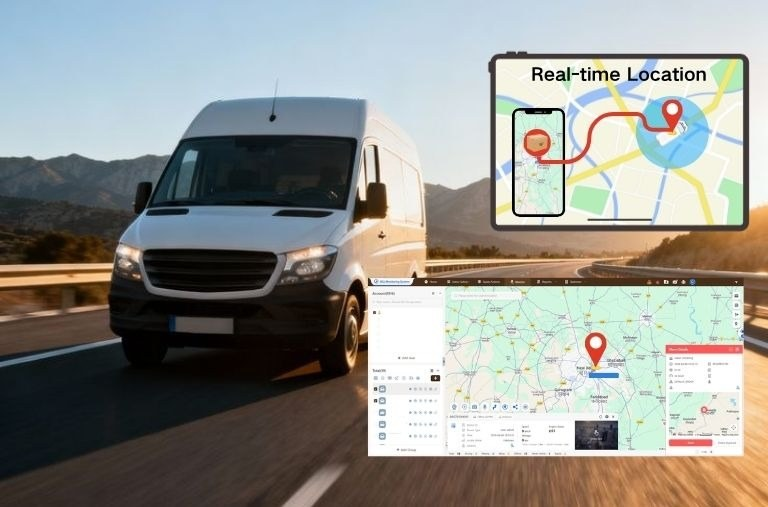
Delivery vehicles operate on dense schedules where small delays can multiply across dozens of stops. GPS tracking gives dispatchers location visibility, but a procurement decision should extend beyond the question of whether a map can show a van in real time. For delivery teams, fleet and delivery management depends on update frequency, route history, geofences, alert logic, device reliability, installation quality, and integration with the software used to plan and confirm deliveries.
A last-mile delivery fleet also generates different operating patterns from long-haul transport. Frequent stops, short routes, customer time windows, parking constraints, driver changes, and urban connectivity conditions all affect how tracking data is interpreted. Buyers get more value when the evaluation criteria are based on those daily workflows rather than on a generic feature list.
Evaluate Position Data in the Context of Delivery Workflows
Location accuracy is only one part of useful tracking. Dispatch teams need to know whether updates arrive at a frequency that supports route decisions, whether trip history can be replayed, and how the system behaves when cellular coverage drops. A tracker that stores data during an outage and forwards it after reconnection can preserve a more complete route record than one that simply stops reporting.
Geofences can support depot departures, customer arrivals, restricted zones, and proof-of-presence workflows, but they require careful design. If boundaries are too small or alerts trigger too quickly, normal GPS variation may create noise. If they are too broad, arrival timestamps lose meaning. Delivery operations teams using fleet and delivery management should test geofence behavior on representative routes before using the data for performance measurement.
Historical context matters when a customer disputes a delivery window or a dispatcher investigates an unusual stop. A well-planned last mile delivery fleet can use route playback, stop duration, ignition data, and selected alerts to create a consistent operational timeline. Those records should support review without turning routine driver activity into unnecessary surveillance.
Driver communication is another evaluation point because location data affects daily behavior. Policies should explain which information is collected, how long it is retained, and how exceptions are reviewed. Clear operating rules can reduce disputes and help supervisors focus on route performance, customer service, and safety rather than using tracking data as a substitute for direct management.
Check Installation, Connectivity, and Device Maintenance
Small commercial vehicles may have limited installation space and can move between drivers or depots. Hardware should be mounted where it receives reliable GNSS signals, remains protected from accidental damage, and can be serviced without dismantling major interior components. Power wiring also needs to match the vehicle and preserve tracker operation across expected ignition states.
Network planning is especially important for urban fleets that move through underground loading areas, dense buildings, or regional coverage boundaries. Procurement teams need to check supported bands, SIM strategy, roaming, offline storage, and the data volume created by the selected reporting interval. The most frequent update is not always the most useful if it raises cost without changing dispatch decisions.
For small commercial vans, BSJ Technology combines GPS tracking with options for AI dashcams, route visibility, driver-safety monitoring, and cloud-based management. For distributors and system integrators, the hardware choice can therefore be evaluated together with firmware management, accessory compatibility, and the interfaces required by the customer’s existing application.
Power behavior needs to be tested during the frequent ignition cycles typical of delivery work. A tracker may report normally on a long drive yet behave differently when a van makes dozens of short stops. Commissioning should confirm startup time, sleep behavior, backup-power expectations, and whether the selected wiring method produces unwanted battery drain during overnight parking or weekend storage. The commissioning record can note these results by vehicle model so future installations do not repeat the same electrical troubleshooting.
Measure Whether Tracking Improves Delivery Control
Ahead of volume rollout, a representative route evaluation should test operational outcomes rather than only installation success. Useful measures include the accuracy of arrival and departure records, time required to locate a delayed vehicle, percentage of missed location reports, false geofence events, and whether dispatchers can resolve exceptions faster. These results reveal whether the tracking design fits the workload before a larger purchase is approved.
BSJ Technology also identifies flexible OEM/ODM cooperation, hardware engineering, and third-party platform compatibility among its commercial-project strengths. Those capabilities can matter when a fleet solution provider needs branded hardware, custom I/O behavior, or integration with platforms such as Wialon or GPSGate. Technical validation remains necessary because each project can use different event fields and operating rules.
The best evaluation therefore connects device performance to service performance. Reliable positioning, practical reporting intervals, clean installation, manageable alerts, and usable historical records should make delivery exceptions easier to understand and resolve. When the tracking layer supports those tasks consistently, it becomes a working component of delivery operations rather than an isolated map feature.
Integration testing can include customer-facing milestones where relevant. Arrival records, proof-of-presence data, or route exceptions may need to pass into order-management or service systems. The project team should confirm which fields are exported, how late data is handled, and whether a change in tracker configuration can alter downstream delivery reports without warning.
