Choosing a generator for commercial, construction, agricultural, or backup-power applications involves more than comparing the headline wattage or purchase price. Business buyers need equipment that can deliver suitable power, operate reliably, and fit the practical requirements of the intended site. For companies evaluating the best quality generator, several technical and operational characteristics deserve closer comparison before a purchasing decision is made.
Start With Actual Power Requirements
Power capacity is one of the first specifications buyers should examine. Generator ratings commonly distinguish between starting watts and running watts. Starting watts represent the temporary power available for equipment that requires additional energy when its motor starts, while running watts indicate the power the generator can continuously provide.
A suitable generator therefore needs enough running capacity for the expected continuous load while also accommodating starting requirements. Buyers should calculate the combined demand of the equipment they intend to operate rather than selecting a model based only on its maximum output.
For commercial users, this approach can reduce the risk of overload and make generator selection more closely aligned with actual operating conditions. It can also help purchasing teams compare models from different power equipment manufacturers on a consistent basis.
Examine the Alternator and Winding Construction
The alternator is another critical area for comparison because it converts mechanical energy from the engine into electrical energy. Buyers should look beyond general descriptions and examine the alternator’s design, winding material, excitation method, and other available specifications.
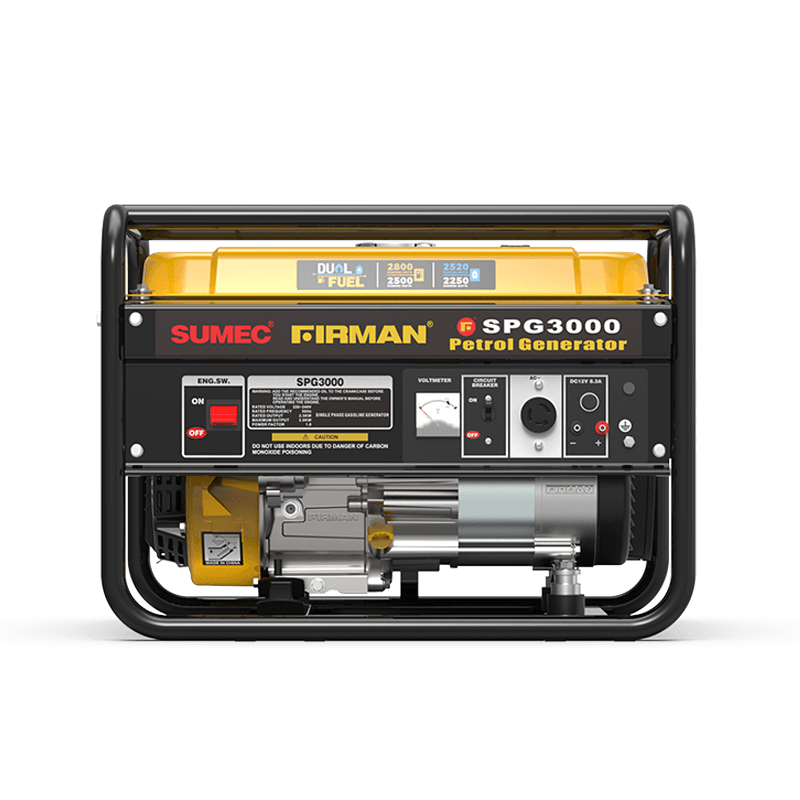
The Firman SPG3000, for example, uses a brush, self-exciting, synchronous, two-pole alternator with 100% copper enamelled wire.
Copper winding construction can be particularly relevant when buyers are assessing generator durability and electrical performance. The SPG3000’s 100% copper winding and alternator specifications give professional buyers concrete characteristics to consider rather than relying only on general marketing descriptions.
Consider Fuel Flexibility and Operating Duration
Fuel arrangements can affect the practicality of a generator across different operating environments. Buyers should check the fuel system, available fuel options, tank capacity, and expected operating duration under a defined load.
The dual-fuel version SPG3000 is presented by Firman as a petrol/LPG generator with the 15L fuel tank. Its official specification lists an approximate runtime of 14 hours on one tankful at 50% load.
For business purchasers, runtime can matter as much as rated output. Longer operation between refueling intervals may be useful for temporary worksites, outdoor operations, or backup applications where frequent intervention is inconvenient.
Compare Noise, Size, and Site Practicality
Noise should not be treated as an afterthought, particularly when generators operate near workers, customers, residential properties, or other businesses. Buyers should compare noise figures using the same measurement distance and test conditions to avoid misleading comparisons.
Firman lists the SPG3000 at 68dB when measured at 7 meters. The unit also uses an open-frame design, has a gross weight of 44kg, and measures 610 × 442 × 465mm in its listed packing dimensions.
These specifications give procurement teams useful information when evaluating transportation, storage, and installation requirements. A generator with appropriate physical characteristics can be easier to integrate into applications where mobility and available space are important.
Look at Starting and Maintenance Requirements
Starting configuration is another practical consideration. A generator may have adequate electrical capacity but still be inconvenient if its starting system does not match the user’s operating environment.
The SPG3000 uses a recoil starting system and is equipped with the SFE200 engine. Its listed oil capacity is 0.6L. Buyers should consider these specifications alongside their maintenance procedures, operator requirements, and expected usage frequency.
It is also important to assess the manufacturer’s broader support capabilities. Firman is a global power equipment manufacturer, with power-generation equipment serving home, outdoor, and industrial applications. The company states that its brand is registered in 106 countries and regions and that its products are sold in more than 160 countries and regions.
Evaluate Manufacturers as Well as Individual Models
A generator purchase is ultimately a decision about both equipment and supplier reliability. Procurement teams should investigate a manufacturer’s product range, technical capabilities, quality approach, service resources, and experience in relevant markets.
Focusing exclusively on the cheapest available model can make it harder to evaluate long-term operating value. Instead, buyers can create a comparison framework covering output, alternator construction, fuel capacity, runtime, noise, starting method, dimensions, weight, and manufacturer support.
Firman’s SPG3000 illustrates how detailed specifications can support this process. With 2.8kW starting watts, 2.5kW running watts, a 15L fuel tank, 68dB noise level at 7 meters, and a 100% copper-wound alternator, the model provides measurable characteristics that buyers can compare against their application requirements.
Making a More Informed Generator Decision
The best quality generator is not necessarily the model with the highest output or the lowest purchase price. For business buyers, quality should be evaluated through a combination of electrical performance, alternator construction, fuel arrangements, runtime, noise, portability, starting method, maintenance requirements, and manufacturer capabilities.
A structured comparison can help purchasing teams identify equipment that fits both technical requirements and operational realities. Models such as the Firman SPG3000 demonstrate why detailed specifications are valuable during this process. By comparing measurable performance characteristics rather than relying on headline claims, businesses can make more practical and defensible generator purchasing decisions.
