Residential electrical systems may appear simple, but they contain multiple circuits serving lighting, sockets, kitchen appliances, HVAC equipment, water heaters, and other loads. Each circuit requires suitable protection against conditions such as overload, short circuit, and electrical leakage. Choosing the right breaker is therefore an important part of designing a safe and reliable installation.
For electrical professionals, distributors, installers, and project purchasers, selecting electrical control products involves more than choosing a rated current. The protection device must correspond with the circuit design, expected load, installation environment, and applicable requirements. MAXGE provides a range of circuit protection products that can support different residential and light commercial applications.
Start with the Circuit and Its Expected Load
The first step in selecting a breaker is understanding the circuit it will protect. Different circuits can have significantly different load characteristics, so the rated current of the protective device should be selected according to the conductor, equipment, and system requirements.
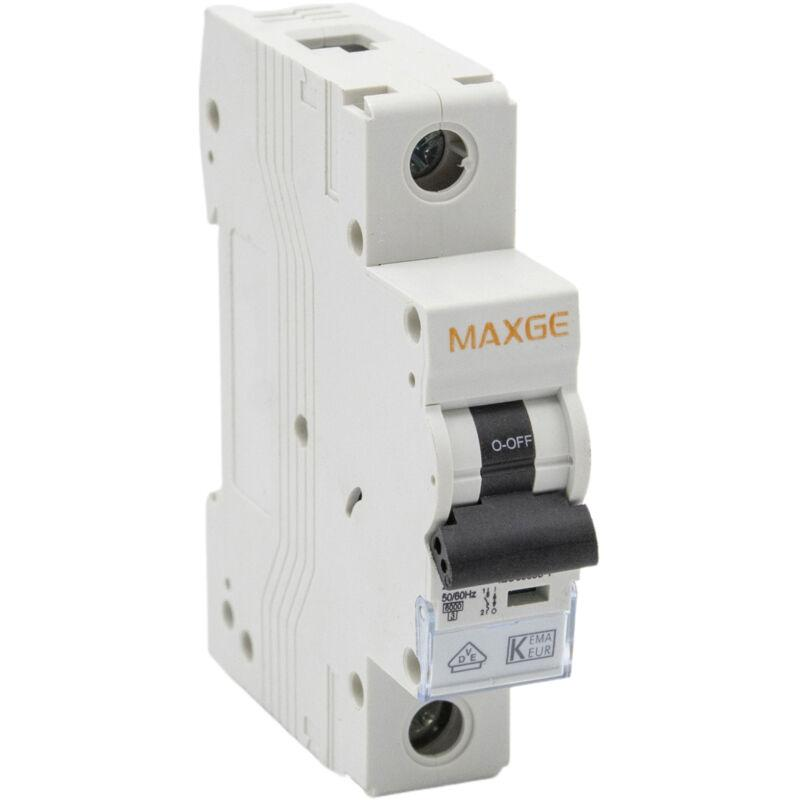
A miniature circuit breaker is commonly used for terminal circuits because of its compact size and straightforward installation. MAXGE describes its miniature circuit breakers as suitable for small-capacity circuits in homes and offices, with applications including residential and commercial lighting and socket circuits.
A miniature circuit breaker 20-amp model may be appropriate for a circuit designed around a 20 A protective rating, while a 32-amp miniature circuit breaker can be considered where the circuit requirements call for a higher rated current. The correct choice should never be based simply on the appliance’s maximum power. Cable capacity, voltage, circuit configuration, ambient conditions, and local electrical requirements should also be evaluated.
Understand the Difference Between Overcurrent and Leakage Protection
Overcurrent protection and residual current protection address different electrical risks. An MCB is primarily intended to interrupt excessive current caused by overloads or short circuits. Residual current protection, on the other hand, is designed to detect leakage current and disconnect the circuit when the leakage reaches the relevant threshold.
This distinction is particularly important when specifying protection for residential circuits. An RCCB for home applications can provide residual current protection, helping address electrical leakage that may not be detected by an ordinary MCB.
MAXGE’s RCD and RCBO product range includes residual current circuit breakers as well as residual current circuit breakers with overload protection. According to MAXGE, these products are designed for applications including homes, offices, and commercial spaces.
An RCBO can combine residual current protection and overcurrent protection in one device. This configuration can be useful when individual circuits require both functions while maintaining an organized distribution board.
Consider the Breaker’s Rated Current and Characteristics
Rated current is one of the most visible specifications when comparing circuit breakers, but it is not the only factor that matters. A professional selection should also consider the number of poles, rated voltage, breaking capacity, tripping characteristics, installation method, and compatibility with the distribution system.
For example, selecting between a miniature circuit breaker 20-amp model and a 32-amp miniature circuit breaker should depend on the actual circuit requirements rather than simply choosing the higher rating. Oversizing protection can prevent the device from providing the intended protection for the conductor, while an undersized breaker may cause unnecessary tripping during normal operation.
MAXGE’s MCB portfolio includes multiple series, including EPB-63H, EPB-63M, EPB-63Me, EPB-63Ne, EPB-63Se, SG-DPN, and other miniature circuit breaker models designed for terminal distribution applications.
Think About Maintenance and Installation
Residential protection equipment should also be practical for installation and future maintenance. Clear operating indications, stable mounting, accessible terminals, and suitable accessories can make routine inspection and replacement easier.
MAXGE’s EPR-2 and SGR-2 product information highlights features such as test buttons, visualization windows, ergonomic handles, stable installation, and accessory compatibility. The SGR-2 RCCB documentation also recommends regular checking and emphasizes selecting the appropriate current specification, tripping type, and conductor cross-sectional area according to the load.
These considerations become increasingly important when a distribution board contains multiple protected circuits. A well-selected combination of MCBs, RCCBs, and RCBOs can make the protection arrangement easier to understand and maintain.
Selecting Electrical Control Products for Different Projects
There is no single breaker specification suitable for every residential installation. A small lighting circuit, a socket circuit, and a higher-load appliance circuit may have different protection requirements. Similarly, projects with different voltage systems, distribution configurations, and local standards may require different product specifications.
For this reason, product selection should begin with the electrical design and then move to the appropriate product series and rating. MAXGE’s product portfolio includes MCB, RCD and RCBO, MCCB, ACB, smart breakers, distribution boxes, and industrial devices, providing options across different protection and distribution requirements.
For product specifications, technical information, or project requirements, you can review the MAXGE Products range or contact MAXGE directly. MAXGE’s official contact page provides its contact form, email, telephone information, and company locations for further inquiries.
Building a More Reliable Residential Protection Strategy
Choosing residential circuit protection requires a systematic approach. The key is to match each protective device to the circuit’s current, voltage, load characteristics, conductor capacity, and protection requirements. A miniature circuit breaker can provide overload and short-circuit protection, while an RCCB can address residual current protection in appropriate applications. Where both functions are required at the individual circuit level, an RCBO can provide a more integrated protection arrangement.
By evaluating these factors before specifying electrical control products, installers, distributors, and project teams can develop protection systems that are practical to install, operate, and maintain. MAXGE develops low-voltage electrical solutions for residential, commercial, and distribution applications, with its protection portfolio also extending to PV, energy storage, and EV charging systems. Its product development is supported by an R&D team, patented technologies, software copyrights, and testing capabilities including CNAS-related laboratory resources and international certifications.
With automated production at its Deqing and Wuhu manufacturing bases and more than 90% automation, MAXGE combines manufacturing capabilities with ongoing product development to support different electrical protection requirements. This application-focused approach allows residential protection products to be considered as part of a broader low-voltage electrical system rather than as isolated components.
