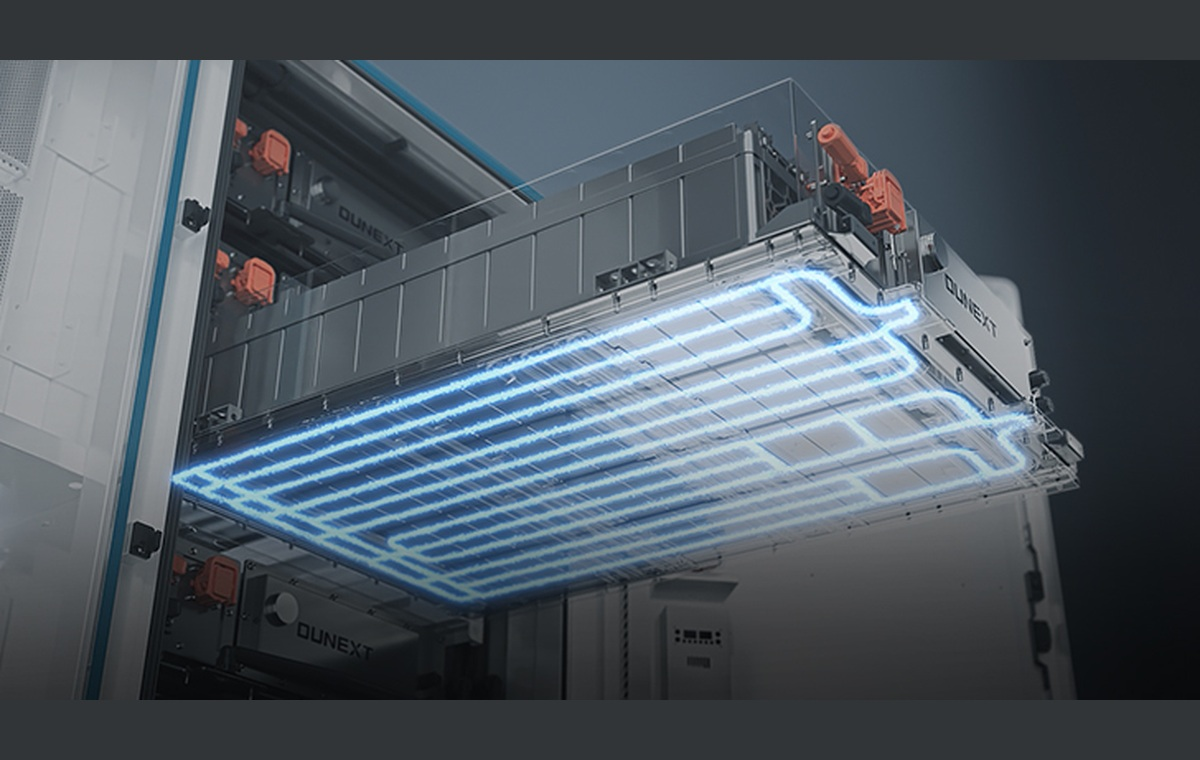
Overheating in battery storage rarely begins as a dramatic event. It often starts with ordinary heat generated during charging and discharging, then becomes a concern when that heat is not removed evenly or quickly enough. As cells operate at different temperatures, their electrical behavior and aging rates can begin to diverge.
A liquid cooled battery energy storage system addresses this problem by creating a controlled path for heat to leave the battery, while monitoring and protection functions keep operation within defined limits.
Why Uneven Temperature Matters?
Battery cells generate heat because current flows through materials with internal resistance. Higher power, repeated cycling, ambient conditions, and restricted heat transfer can all change the thermal load. The most difficult condition is not simply a warm energy storage cabinet but a battery pack in which some cells are consistently hotter than others.
Uneven temperature can produce uneven aging, which gradually makes the pack less uniform and more difficult to manage.
Liquid cooling is used to reduce that thermal spread by carrying heat away through a managed coolant circuit rather than relying only on surrounding air. In a liquid cooled battery energy storage system, the goal is to keep cells within a narrower temperature band so that electrochemical conditions remain more consistent across the pack.
Cooling is therefore not only about preventing a maximum temperature from being exceeded; it also supports more uniform battery operation. That uniformity matters because a pack is controlled as a system even though its individual cells may respond differently to heat.
Thermal Control Works Together With Battery Protection
Cooling cannot replace electrical monitoring or fault protection. A cell can become abnormal because of voltage, current, internal damage, or other conditions that are not solved merely by lowering temperature. Multi-level sensing and protection are needed so abnormal behavior is identified early, giving system controls time to limit a developing fault before heat propagation becomes harder to contain.
Thermal management is strongest when it operates as one layer inside a broader safety architecture.
PowerHill-233kWh, part of Dunext’s C&I storage lineup, combines liquid cooling with six safety layers and uses LiFePO4 280Ah cells. Its liquid cooled battery energy storage system is designed to keep cell temperature spread below 2.5°C.
Beyond routine cooling, the design adds a fire-resistant enclosure rated for two hours, a path for explosion venting, and aerosol suppression at PACK and cabinet levels. Cooling addresses the normal heat load first; the additional measures are reserved for conditions that thermal regulation alone cannot control.
Power Operation Changes the Heat the System Must Remove
Thermal design has to follow the electrical duty of the battery. A cabinet delivering higher power moves more current and can create a different heat load from the same battery operating at a gentler rate. PowerHill-233kWh combines 233 kWh of storage with 105 kW rated charging and discharging power.
Those ratings define the working context in which the energy storage cabinet cooling system must maintain controlled temperatures during repeated charge and discharge activity.
The product also supports constant-power charging and discharging across the full state-of-charge range. For a liquid cooled battery energy storage system, maintaining thermal consistency during changing SOC is valuable because the cooling requirement does not disappear as the battery moves from low to high charge.
Stable control across the operating range reduces the chance that thermal behavior becomes highly uneven only in particular parts of the cycle. It also gives the control system a more predictable thermal baseline from which abnormal conditions can be recognized.
System Integration Prevents Thermal Management From Becoming Isolated
A storage system has to coordinate thermal information with the rest of its operating logic. If temperatures begin to depart from expected values, the control system needs visibility into those conditions alongside inverter status, battery data, and dispatch commands. PowerHill integrates inverter, storage, EMS, and metering management, and Dunext lists intelligent O&M among the product’s design points.
In an energy storage cabinet, that integration gives thermal data a place within wider system operation rather than leaving cooling as a standalone mechanical function.
PV integration is not tied to one topology: the cabinet is specified for both DC-coupled and AC-coupled arrangements. In a three-unit synchronized parallel configuration, on/off-grid switching is specified below 20 ms, while expansion remains available as site requirements grow. Installation is stated at roughly two hours, and operating noise is below 60 dB.
These characteristics are not cooling functions themselves, but they show why a liquid cooled battery energy storage system has to be treated as a complete piece of electrical infrastructure. Thermal management protects battery conditions while the rest of the architecture determines how the cabinet behaves within the site.
Effective overheating prevention therefore depends on both the cooling loop and the information exchanged between battery, control, and operating functions.
Preventing overheating is therefore a continuous control problem, not a single emergency response. Heat must be removed during normal operation, temperature differences must be limited across cells, abnormal behavior must be detected, and stronger protective layers must remain available if a fault develops. PowerHill-233kWh illustrates that hierarchy through sub-2.5°C thermal spread, liquid cooling, layered protection, and integrated monitoring.
The practical value of liquid cooling lies in keeping the battery thermally consistent before overheating becomes a system-level problem.
