A step-through latency value can be affected by much more than memory retention. In a passive avoidance experiment, the animal’s natural preference for darker spaces, exposure to the apparatus, door timing, aversive stimulus, and scoring rule can influence when it enters the opposite compartment.
Treating these variables as part of the protocol helps researchers interpret latency data with greater context.
Define the Passive Avoidance Test Endpoint
Passive avoidance measures whether an animal learns to refrain from entering a compartment previously associated with an aversive stimulus.
In the common step-through design, the rodent begins in a light compartment and can move into a darker compartment, where the aversive event is delivered during training. A later trial measures how long the animal remains in the light side before entering the dark side.
Researchers can specify whether the recorded measure is step-through latency, dark-zone time, or another protocol-defined variable. A clear endpoint makes results easier to compare across treatment groups.
Account for Natural Light-Dark Preference
The animal’s baseline behavior can influence acquisition latency and later retention measurements. A strong tendency to enter the dark compartment may shorten the initial step-through time, while unusual hesitation can alter the baseline.
Accordingly, familiarization and baseline observations should be incorporated into protocol design. Maintain consistency within a study for testing environment, light level, chamber arrangement, handling sequence, and inter-trial interval.
Published passive-avoidance protocols vary in acclimation duration and timing; no universal schedule applies.
Standardize Door Timing and Movement Detection
The interval between placing the animal in the light compartment and opening the door can affect the opportunity for exploration. The door’s position, opening behavior, and the definition of a completed transition should also be consistent.
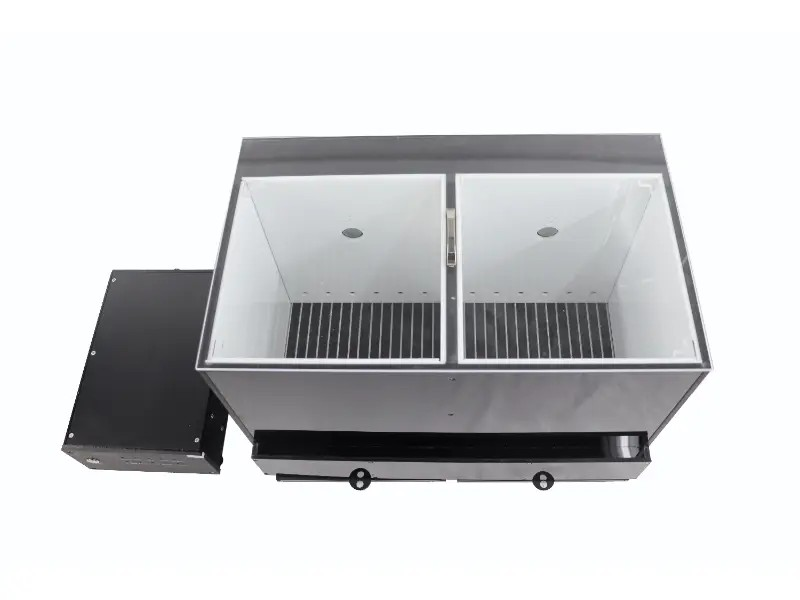
BioMed Easy‘s SA223 Automated Shuttle Avoidance Test uses automatic doors in both compartments. Door opening and closing speed can be set from 2–8 cm/s, while closing distance is adjustable from 1–10 cm. Independent infrared detection in each chamber records movement and transitions, reducing the need for manual event timing.
Set the Aversive Stimulus Carefully
Shock intensity and duration can affect behavior during acquisition and therefore influence subsequent latency. These parameters should come from the approved experimental design and animal-welfare framework rather than being chosen simply to produce a longer retention latency.
The SA223 provides AC current from 0.1–4.0 mA in 0.1 mA steps. It also supports independent shock-grid control for each chamber, while sound and light can be configured separately.
Establish the Cutoff Before Testing
A cutoff sets a defined boundary when an animal does not enter the dark compartment. It also creates a consistent basis for recording latency and handling non-entry cases. The selected limit should be specified before testing and applied according to the study protocol.
The SA223 records passive-avoidance cross latency and cutoff times. Its passive-avoidance data fields also include door-open time, cross time, cross latency, cutoff times, status, and start and end times. These records allow researchers to review latency in relation to the trial sequence.
Keep the Physical Context Consistent
Contextual differences can influence behavior independently of the treatment under investigation. Chamber dimensions, lighting, odors, cleaning procedures, room conditions, and operator activity can all become relevant sources of variation.
The SA223 provides mouse and rat chamber configurations. The mouse chamber has exterior dimensions of 43 × 30 × 32 cm and an interior space of 20 × 20 × 20 cm. A top-loading door allows access to the chamber, and an optional sound-attenuating cubicle with a sound level below 40 dB is also listed.
Review Data Beyond a Single Latency
Step-through latency is useful, but a broader record can provide additional context. Consider whether the study also needs dark-zone time, bright-zone time, cross latency, or other protocol outputs. Retaining the session details can help identify unexpected procedural differences during analysis.
The SA223 can export data in CSV format for further analysis and supports independent software control for each channel. Up to 32 independent rodent chambers can be operated simultaneously, and different chambers can run different protocols at the same time.
Select Equipment Around the Full Workflow
A useful passive avoidance test workflow connects baseline behavior, chamber conditions, transition detection, stimulus delivery, cutoff rules, and data recording. Evaluating these elements together gives researchers a clearer basis for selecting equipment and defining the study protocol.
BioMed Easy Technologies develops laboratory animal and neuroscience research equipment under the parent company SANS Biotechnology. The official site lists a 2016 founding year, CE and ISO9001 certifications, and support for 3,000+ laboratories globally.
Its portfolio covers Motor Coordination, Pain and Inflammation, Learning & Memory, Anxiety, Fear & Emotion, and Reward & Addiction.
The SA223 Automated Shuttle Avoidance Test supports passive avoidance, active avoidance, and learned helplessness through automated doors, configurable sound, light, and shock stimuli, independent chamber control, and CSV data export.
Laboratories planning passive avoidance studies can review the official specifications and ask BioMed Easy about animal models, channel requirements, and available support.
