The question that comes up in nearly every RFID sourcing conversation isn’t which reader format performs better — it’s which one fits the installation in front of you.
Fixed and integrated UHF RFID readers can hit similar maximum read ranges on a spec sheet, so the deciding factor usually sits somewhere else: how the antenna is mounted, how many points need coverage, and how much cabling a site can reasonably support.
RSTC produces both formats, and running through their actual differences side by side makes the choice easier than comparing dBm numbers alone.
The Core Difference at a Glance
| Fixed UHF RFID Reader | Integrated Reader | |
| Antenna | External, connected via SMA/TNC ports | Built into the housing |
| Example models | RS-F905 (4-port, Impinj E710), RS-PR03 (Impinj R2000, Linux OS) | RS-PI12LA01(12dBi), RS-PI09CA01 / RS-PI09LA01 (9dBi) |
| Read range | Up to 25m, depends on antenna choice | 0–25m (RS-PI12LA01), fixed by built-in antenna |
| Output power | 5–33dBm, adjustable per antenna | +20 to +30dBm, factory-set |
| Best suited for | Multi-lane docks, wide openings, production lines | Single-point checkpoints, gates, compact installs |
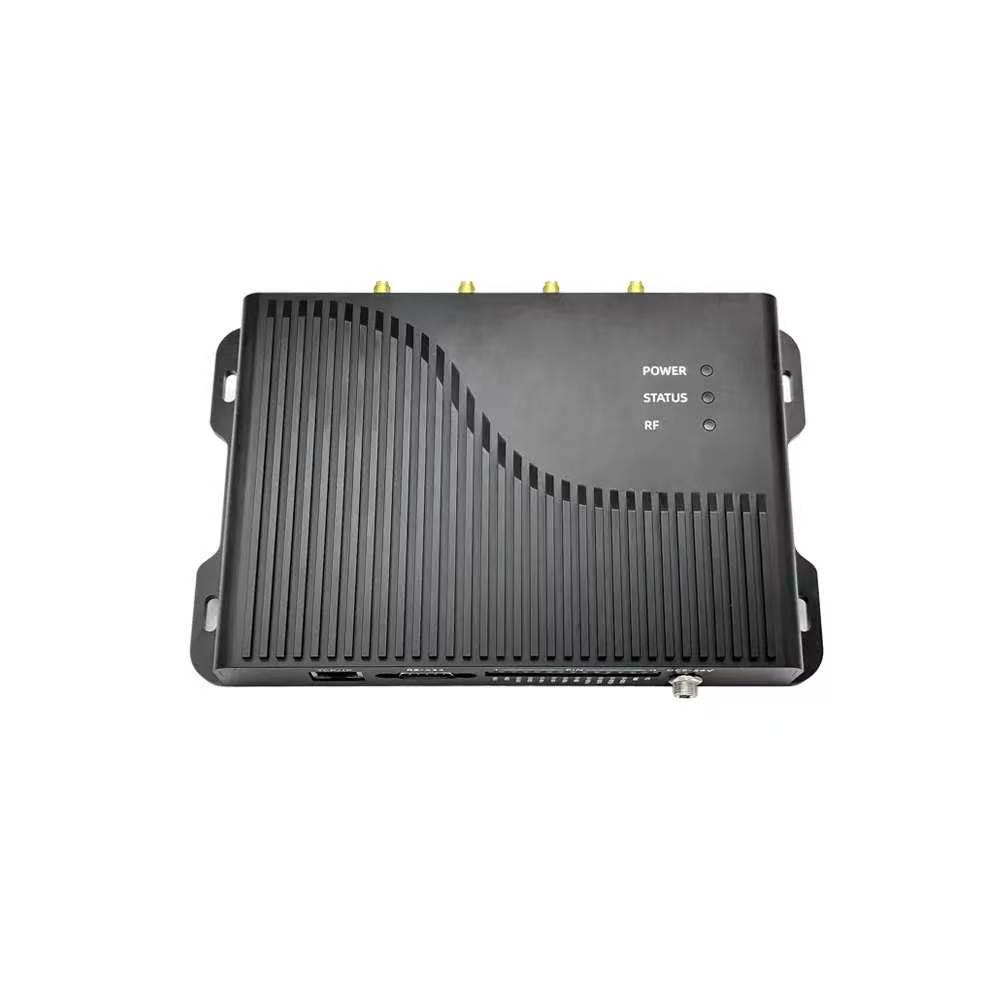
A fixed UHF RFID reader is really just the processing unit — the antennas are a separate purchase, wired in through SMA or TNC connectors, and can be positioned wherever the layout calls for.
An integrated reader skips that step by building the antenna into the same enclosure as the reader electronics, which is why RSTC lists its RS-PI12LA01 and RS-PI09 series as complete, ready-to-mount units rather than components to be paired later.
Signs a Fixed Reader Is the Better Fit
A fixed configuration tends to make more sense when:
- Multiple antennas need to cover one area. The RS-F905’s four SMA ports let one reader unit handle four separate antenna positions, useful for a dock door wide enough that a single antenna can’t see the whole opening.
- Antenna placement needs to change over time. Because the antenna is a separate part, it can be repositioned, swapped for a higher-gain model, or added to without replacing the reader itself.
- The site has uneven geometry. Staggered ceiling heights, multiple lanes, or L-shaped receiving bays are easier to solve with antennas placed individually than with one fixed radiation pattern.
- Environmental durability matters at the reader end. The RS-PR03 is rated from -40°C to +60°C, which can support installations exposed to a wide temperature range; the antenna and other outdoor components should be evaluated against their own environmental specifications. RSTCbuilds several of its fixed models on this same Impinj R2000 platform, so the temperature tolerance carries across the modular lineup rather than varying model to model.
Signs an Integrated Reader Is the Better Fit
An integrated unit tends to win out when:
- The installation is a single point, such as a parking barrier, a personnel checkpoint, or a narrow gate where one antenna angle covers the whole read zone.
- Cabling runs are impractical or costly. Skipping the antenna cable removes a common point of signal loss and cuts installation labor, particularly for outdoor or remote sites.
- Weatherproofing needs to be built in from the start. RSTC’s RS-PI12LA01 ships IP65-rated as a complete unit, so there’s no separate antenna enclosure to weatherproof on-site — a meaningful saving in labor for outdoor gate or barrier installations where a separate junction box would otherwise be needed.
- Setup speed matters more than tuning flexibility. Mount the bracket, connect power and Ethernet, and the read pattern is already defined by the built-in antenna — no separate gain calculation needed.
Where Teams Get the Spec Sheet Wrong
The most common mistake isn’t picking the wrong format outright — it’s assuming the maximum read-range figure on a data sheet will hold regardless of installation. A fixed reader’s 25-meter rating depends on which antenna gets paired with it; swap in a lower-gain antenna, run a longer cable, or angle the antenna away from the tag’s polarization, and that number drops well below what the spec sheet promised.
An integrated reader’s rating is more fixed by design, since the antenna is already chosen at the factory, but it still shifts with mounting height, tag orientation, and obstructions such as racking or parked vehicles in the field.
Neither format is exempt from these real-world variables, which is why testing on the actual installation surface, not a lab bench, remains the only reliable way to confirm performance before a full rollout gets underway.
Making the Call for a Specific Site
Large sites rarely need to pick just one format. A distribution center might run fixed readers with multiple antennas across its dock doors while using integrated units at a smaller side entrance where running cable isn’t worth the labor, and a manufacturing plant could mix both across a production line and its shipping yard without any conflict between the two systems.
RSTC evaluates antenna placement, tag type, and installation conditions for each project before recommending a hardware mix, since real-world deployment factors — metal interference, moisture, vibration, temperature — tend to surface constraints that a spec sheet alone won’t catch.
For teams weighing UHF RFID Readers against a specific facility, starting with the installation points rather than the headline read-range figure is what actually narrows the decision down to something workable on the ground.
