Cryopreservation is not merely a standardized storage process; it is a complex, cell-specific scientific discipline foundational to modern biotechnology and the rapidly expanding field of Cell and Gene Therapy (CGT). For researchers and bioprocessing professionals, the long-term viability and functionality of precious cellular material hinge critically on the cryopreservation medium CHOsen.
The key to successful long-term cell banking is overcoming the fundamental challenges of thermal and osmotic stress. Improper protocols or poorly optimized cell freezing media can lead to significant reductions in post-thaw viability, recovery, and functionality—ultimately jeopardizing costly research or clinical trials. Optimization, therefore, begins with recognizing that no single formulation is universally appropriate; every cell type requires a tailored approach.
The Core Principles of Successful Cryopreservation
At its heart, cryopreservation seeks to mitigate cellular damage caused by ice crystal formation. The generally accepted protocol is the “slow freeze, quick thaw” technique.
- Cryoprotective Agent (CPA) Action: The freezing medium must contain a Cryoprotective Agent, most commonly Dimethyl Sulfoxide (DMSO) at a typical final concentration of 10%. DMSO is a permeating CPA that lowers the freezing point of the solution and helps dehydrate the cell, preventing lethal intracellular ice crystal formation. However, DMSO is cytotoxic, underscoring the need for rapid handling and immediate removal post-thaw.
- Controlled Cooling Rate: The ideal cooling rate for most mammalian cells is approximately -1°C per minute until the sample reaches -80°C. This controlled cooling ensures water efflux from the cell, concentrating solutes and minimizing intracellular ice formation.
- Osmotic Pressure Management: During the freezing process, extracellular ice formation causes the remaining liquid to become hyperosmotic, drawing water out of the cell. An optimized freezing medium formulation manages this osmotic shock, ensuring the cell membrane remains intact throughout the water exchange process.
While these core principles apply universally, the precise combination of CPAs, basal media, and supplements must be customized based on the cell’s biology.
Choosing the Optimal Cell Freezing Media Formulation
The selection of a cell freezing media is an advanced optimization step, moving beyond the simple addition of DMSO to a complete culture medium. Different cell types possess unique membrane properties, water content, and growth requirements, demanding specialized cryopreservation solutions.
- Hematopoietic and Immune Cells (T-cells, NK Cells): These suspension cells are relatively robust but require media that maintain high viability for clinical applications. Given their use in immunotherapies, formulations must be completely free of animal-derived components to comply with regulatory standards and minimize the risk of xenogenic contamination.
- Mesenchymal Stem Cells (MSCs): MSCs and other progenitor cells are highly sensitive to freezing stress. Optimization for MSCs often focuses on defining specific non-permeating CPAs or sugars (like trehalose) that help stabilize cell membranes and proteins extracellularly, alongside DMSO.
- Adherent Cells (CHO, HEK293): Often used in Biopharma for protein expression, these cells must be harvested gently while maintaining high viability before freezing. The media must stabilize them immediately following enzymatic detachment. Consistency in viability and yield is paramount for maintaining reliable production master cell banks.
- Induced Pluripotent Stem Cells (iPSCs): iPSCs are notoriously challenging. They are often frozen as aggregates, requiring specialized formulations that ensure cryoprotectant penetration across the entire cluster, or they are frozen using vitrification methods which bypass controlled-rate freezing entirely.
In high-stakes CGT applications, the industry standard is rapidly moving away from traditional, ill-defined media (like those containing Fetal Bovine Serum, or FBS) toward serum-free and chemically defined options. FBS, while effective for some cells, introduces lot-to-lot variability and potential regulatory risk, making it unsuitable for GMP-compliant manufacturing.
Mitigating Risk: The Shift to Defined, GMP-Grade Solutions
For companies engaged in Biopharma and Gene Therapy, regulatory compliance and batch-to-batch consistency are non-negotiable. This demand drives the necessity for freezing solutions that are not only scientifically effective but also meet stringent manufacturing and documentation standards.
ExCell Bio, a leader in CGT media and bio-pharmaceutical materials, addresses this critical market gap by focusing specifically on high-grade, defined media solutions. Their product development is centered on ensuring media formulations are precisely reproducible and fully traceable, eliminating the variability inherent in serum-containing products.
The shift to defined media in cryopreservation is driven by two factors:
- Consistency: Defined media ensure that every vial of frozen cells is exposed to the exact same components in the exact same concentrations, dramatically improving process control and reproducibility in large-scale manufacturing.
- Regulatory Compliance: Using GMP-grade, serum-free, and animal-component-free (ACF) media simplifies the regulatory pathway for clinical products, reducing the risk of transmitting adventitious agents and satisfying the most rigorous health authority requirements globally.
This adherence to defined, high-quality standards is vital for maintaining the stability and functional integrity of cells throughout the entire CGT workflow—from research and development to commercial production.
Advanced Cryopreservation with ExCell Bio’s Optivitro® Medium
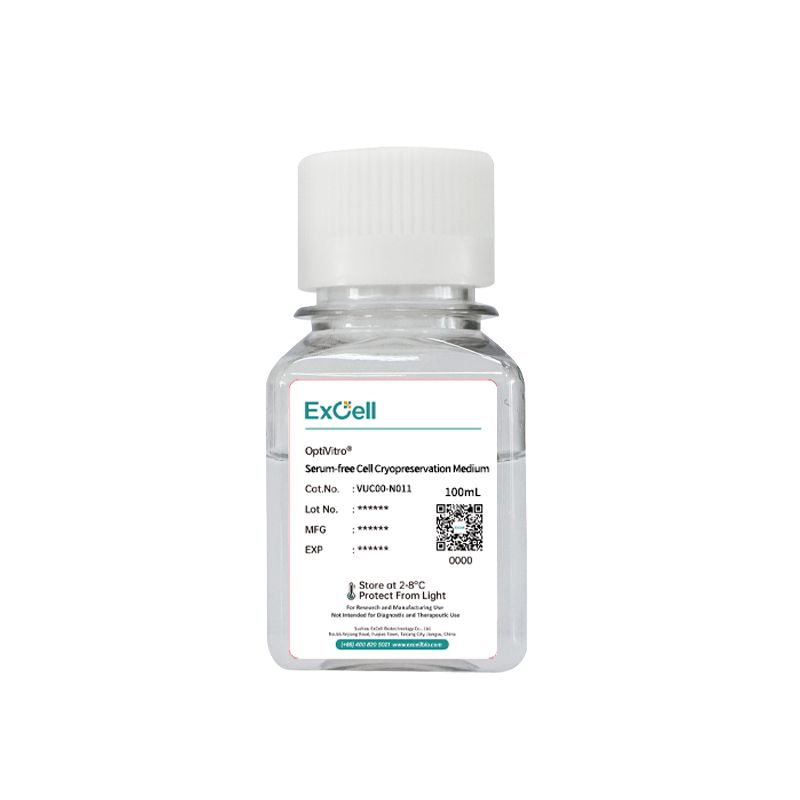
To meet the specialized needs of therapeutic cell lines, ExCell Bio offers solutions engineered for advanced clinical applications. A prime example is their Optivitro® Serum-free Cell Cryopreservation Medium UC04.
This product is an expertly formulated, ready-to-use solution designed to simplify the cryopreservation process while maximizing post-thaw cell recovery for multiple cell types used in cell therapy.
| Feature | Specification | Clinical/Biopharma Benefit |
| Formulation | Serum-free and Ready-to-use | Eliminates serum variability and reduces preparation steps. |
| Regulatory Status | GMP grade, DMF filed | Essential for meeting regulatory requirements in clinical and commercial manufacturing. |
| Storage Range | –80℃ to –196℃ | Supports both short-term ultra-low temperature freezer storage and long-term liquid nitrogen vapor phase storage. |
| Target Application | Cell Cryopreservation, Cell Therapy | Specifically validated for preserving high-value therapeutic cells. |
The Optivitro® UC04 medium is a definitive step toward process optimization. By providing a chemically defined, robust, and regulatory-ready solution, ExCell Bio allows researchers and manufacturers to bypass the time-consuming and inconsistent practice of developing ‘home-brew’ freezing solutions, ensuring maximum cell viability and functionality for the next phase of development.
In the complex landscape of cell therapy and bioprocessing, the performance of your freezing medium directly correlates to the success of your final product. Optimizing your cryopreservation protocol by selecting a high-quality, cell-specific, and GMP-compliant medium is the most effective way to safeguard your cell lines and accelerate your path to therapeutic success. Partnering with companies like ExCell Bio that specialize in GMP-grade defined media ensures both scientific excellence and regulatory peace of mind.
