Choosing an antenna for a global navigation system is not simply a matter of finding a component labeled “GPS antenna.” The suitable design depends on the signals a receiver must process, the positioning accuracy required, the equipment in which it will operate, and the environment surrounding the antenna. For B2B buyers, the real question is therefore not which antenna is universally best, but which antenna type fits the intended positioning architecture.
Why One GNSS Antenna Does Not Fit Every Positioning System?
A navigation receiver can be paired with very different antenna designs depending on its role. A compact controller embedded in machinery has different constraints from a surveying receiver mounted on a tripod. Vehicle guidance, construction equipment, agricultural machinery, and fixed infrastructure can also impose different requirements.
Signal coverage is one of the first dividing points. A system using only one satellite frequency has a narrower antenna requirement than a receiver designed to process several bands. Antenna selection should therefore begin with the receiver’s supported signals rather than with physical appearance or price.
The surrounding installation also matters. Enclosures, metal surfaces, cables, nearby electronics, and mounting structures can influence how an antenna performs after integration. Consequently, antenna specifications should be evaluated as part of the complete positioning solutions.
Single-Band or Multi-Band: Which Signal Coverage Is Actually Needed?
Single-band antennas can suit positioning equipment with straightforward signal requirements. Multi-band antennas become more relevant when the receiver is designed to use observations across multiple frequencies and constellations. Multi-frequency reception is particularly relevant to high-precision GNSS workflows because measurements from different frequencies can contribute to positioning algorithms.
Global navigation satellite systems include GPS, GLONASS, Galileo, BeiDou, QZSS, and other constellations operating across different frequency bands. An antenna intended for broad multi-constellation use therefore needs frequency coverage compatible with the receiver.
The practical rule is simple: antenna frequency coverage should match the receiver’s measurement architecture. Specifying a multi-band antenna for equipment that cannot use those signals may add unnecessary cost, while using a limited-band antenna with a more capable receiver can constrain the overall system.
Embedded Patch, External, or Survey Antenna?
Physical form becomes the next selection question once signal requirements are established. Patch antennas are attractive for compact equipment because they can occupy relatively little space and can be integrated into electronic assemblies. Their performance, however, depends strongly on the surrounding ground plane and enclosure design.
External antennas offer greater flexibility when the antenna needs to be positioned away from electronics or placed where satellite visibility is better. Such configurations are common in vehicle and machinery installations where the receiver can remain inside a protected enclosure while the antenna is mounted externally.
Survey-oriented systems introduce another level of requirement. A dedicated external antenna may be preferable when repeatable measurements, stable mounting, and controlled reception characteristics are more important than compact packaging.
Archimedes Innovation provides antenna products intended for different GNSS positioning configurations, including AI-C8L1, AI-16L1P, AI-16L116L5, AI-C16L1, AI-C8L18L5, and AI-4L14L2. The appropriate model should be matched to the receiver and intended deployment rather than selected solely by product category.
When Does an Active Antenna Make More Sense?
The distinction between active and passive antennas becomes important once the distance between antenna and receiver is known. A passive antenna receives the satellite signal without integrated amplification. It can be suitable when the antenna is close to the receiver and cable losses remain manageable.
An active antenna incorporates amplification to compensate for losses in the signal path. This can be useful when the antenna is installed some distance from the receiver, such as on a vehicle roof or machinery platform.
However, active does not automatically mean better. The receiver must support the required antenna power arrangement, while cable type, connector quality, and overall RF loss still need to be considered. A system designer should evaluate the entire antenna-to-receiver path before deciding between active and passive configurations.
What Changes When the Antenna Is Mounted on a Vehicle or Machine?
Vehicle and machinery installations introduce conditions that are rarely present in a laboratory. The antenna may be surrounded by metal structures, moving equipment, electrical systems, or reflective surfaces. Satellite visibility can also change as the platform moves through different environments.
Mounting position consequently becomes part of antenna selection. A roof-mounted antenna may provide a clearer view of the sky than an antenna installed inside a cabin or beneath structural components. For compact machinery, integration space may instead be the dominant constraint.
Mechanical stability matters as well. Movement, vibration, exposure to weather, and repeated operation can affect the long-term reliability of an externally mounted antenna. For this reason, the antenna specification should be considered together with its mounting method and operating environment.
Which Antenna Fits High-Precision Positioning?
The required positioning performance can significantly change the antenna decision. Basic navigation generally has different requirements from surveying, RTK positioning, machine guidance, or applications requiring reliable heading information.
High-precision systems commonly benefit from multi-frequency and multi-constellation reception when the receiver and correction architecture are designed to use those measurements. Antenna quality also matters because unwanted signal effects can become more significant when positioning systems seek higher accuracy.
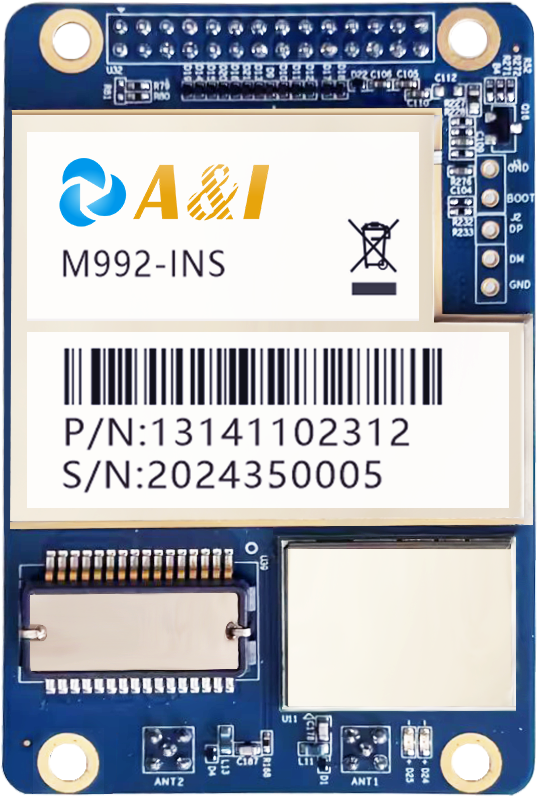
Dual-antenna configurations provide another option for systems that need directional information. Two GNSS antennas can provide a baseline for determining heading when combined with appropriate receiver and processing technology. Archimedes Innovation also offers positioning technologies incorporating GNSS and inertial sensing for applications where position and orientation need to work together.
A Better Way to Specify a GNSS Antenna Before Procurement
A procurement specification should begin with the positioning task rather than a generic request for a navigation antenna. First, define the required accuracy and whether the receiver needs one or multiple frequency bands.
Next, establish the physical deployment. Determine whether the antenna will be embedded inside equipment, installed externally, mounted on a vehicle, or used in a surveying configuration. The available space and surrounding structures should be identified at this stage.
The signal path comes afterward. Cable length, connector arrangement, receiver compatibility, and antenna power requirements can determine whether an active or passive design is appropriate.
Finally, review the complete system rather than judging the antenna in isolation. The receiver, antenna, mounting location, correction source, and intended operating environment all contribute to positioning performance.
The Right Antenna Is a System-Level Decision
There is no single antenna type that represents the best choice for every global navigation system. Single-band designs may meet straightforward requirements, while multi-band antennas can better match receivers intended for more demanding positioning. Compact patch antennas can support embedded equipment, whereas external designs may be more appropriate for vehicles, machinery, and precision field systems.
The most reliable selection starts with the required satellite signals and positioning objective, then works through physical integration, signal-path requirements, and installation conditions. Archimedes Innovation’s antenna and positioning portfolio can be assessed within that broader system context rather than treated as a standalone component catalogue.
For B2B engineering and procurement teams, effective antenna specifications should clearly define operating environment, signal paths, installation requirements, deployment scenarios and required frequency bands. This rigorous approach improves antenna selection accuracy and reduces the risk of selecting components incompatible with the target positioning system.
That approach makes antenna selection more precise and reduces the risk of choosing a component that does not fully support the positioning system it is intended to serve.
